Best Beaches in Brazil: 10 Ranked With Safety Notes (2026)

Jump to section
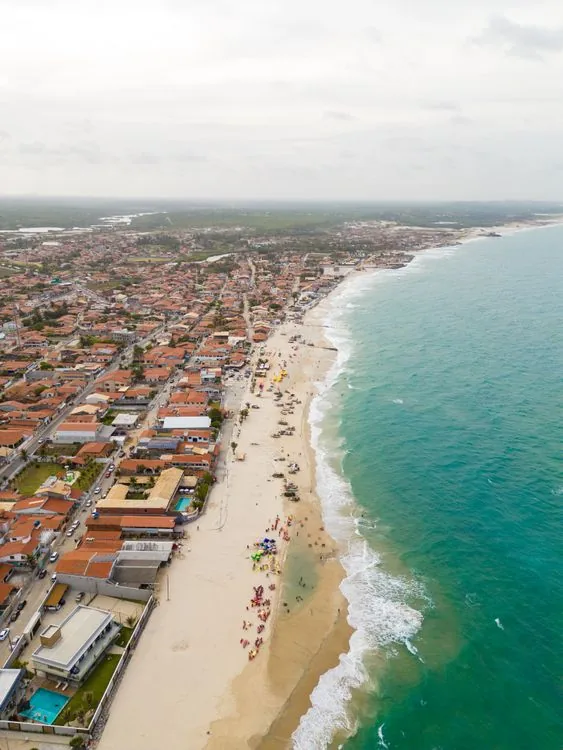
Brazil's coastline mixes calm coves, open Atlantic surf and reef pools, so the right beach depends on the water you want as much as the view.
Updated November 2026. The best beaches in Brazil, in our ranking, are Baía do Sancho on Fernando de Noronha, Praia do Espelho near Trancoso, Patacho in Alagoas, the Azeda coves in Búzios and Jericoacoara, followed by Pipa, Morro de São Paulo, Rio's Prainha and Grumari, Ubatuba and Florianópolis. Each entry pairs the reason to go with the safety or logistics detail that most often catches travelers out.
That second half is what most lists skip. Brazil lists 63 Blue Flag beaches for the 2026/2027 season (Bandeira Azul Brasil, 2026), yet drowning killed 5,883 people in Brazil in 2024 (PAHO/SOBRASA, 2025). A beautiful beach and a safe swim are separate checks.
Key Takeaways
- Brazil has 63 Blue Flag beaches and 12 marinas for 2026/2027; Santa Catarina holds 33 of the beaches and Rio de Janeiro state 19 (Bandeira Azul Brasil, 2026).
- Fernando de Noronha's preservation fee is R$105.79 for one day and R$672.85 for seven in 2026 (Administração de Fernando de Noronha, 2026), on top of the park ticket.
- Rio state's INEA monitors 284 points on 191 beaches and advises staying out of the sea for 24 hours after heavy rain (INEA, 2026).
- Lifeguards cover only about 30% of Brazil's aquatic areas (PAHO/SOBRASA, 2025).
What are the best beaches in Brazil?
Our top 10 spans seven states plus Fernando de Noronha, from the island's marine park to Santa Catarina, home to 33 of Brazil's 63 Blue Flag beaches in 2026/2027 (Bandeira Azul Brasil, 2026). The table gives each beach's best months, the usual way in and the safety note that matters most.
| # | Beach | Region | Best months | Getting there | Safety note |
|---|---|---|---|---|---|
| 1 | Baía do Sancho | Fernando de Noronha (PE) | Aug-Jan | Flight to the island | Park rules, tide-dependent access |
| 2 | Praia do Espelho | South Bahia | Aug-Sep, Jan-Feb | Fly to Porto Seguro, then road | Low-tide pools, dirt road |
| 3 | Patacho | Alagoas | Oct-Mar | Fly to Maceió, then road | Unlit roads after dark |
| 4 | Azeda and Azedinha | Búzios, Rio state | May-Sep | Road transfer from Rio | Crowds and unattended bags |
| 5 | Jericoacoara | Ceará | Aug-Dec | Fly to Fortaleza or the regional airport | Credentialed buggy operators only |
| 6 | Baía dos Golfinhos, Pipa | Rio Grande do Norte | Sep-Jan | Fly to Natal, then road | Cliffs and incoming tide |
| 7 | Morro de São Paulo and Boipeba | Bahia | Sep-Mar | Boat from Salvador or Valença | Afternoon boats in bad weather |
| 8 | Prainha and Grumari | Rio de Janeiro city | May-Sep | Car or app ride from Zona Sul | Surf on big-wave days |
| 9 | Lázaro and the north coast | Ubatuba, São Paulo | May-Aug | Road from São Paulo | Rip currents on surf beaches |
| 10 | Florianópolis and Bombinhas | Santa Catarina | Dec-Mar | Fly to Florianópolis | Weekly water bulletins |
Best months follow 30-year rainfall normals for the nearest station (Climatempo, 2026), weighed against crowds.
How did we rank Brazil's most beautiful beaches?
We scored scenery, water clarity and the effort and risk between you and a good swim, then broke ties with official data: Blue Flag status, which requires at least one water-quality monitoring point per beach (Bandeira Azul Brasil, 2026), and state bathing bulletins.
That is why Rio's Zona Sul beaches miss the top 10. Copacabana and Ipanema are icons, but their water quality swings with rainfall, and we compare them separately in our guide to Rio's beaches and sights.
The 10 best beaches in Brazil, ranked
Four of the ten picks include beaches on the 2026/2027 Blue Flag list, which spans seven states (Bandeira Azul Brasil, 2026). The other six earn their place on scenery and a manageable safety profile, with one practical warning each.
1. Baía do Sancho, Fernando de Noronha
Sancho is a cove of clear water under steep cliffs, reached by a staircase down the rock or by boat. It sits inside the Parque Nacional Marinho, so the park ticket is mandatory (Brasilturis, 2026).
Safety and practical note: budget two charges. The island's preservation fee is R$105.79 for one day and R$901.36 for ten; travelers with a foreign credit card pay at the airport counter, and unplanned extra days cost double (Administração de Fernando de Noronha, 2026). ICMBio set the park ticket at R$384 in November 2025, with 50% off for Brazilians (ICMBio Portaria 4423, 2025), then R$393 for foreigners from 1 November 2026, valid 10 days (Brasilturis, 2026).
2. Praia do Espelho, south of Trancoso
Espelho ("mirror") is named for the still pools that form between reefs at low tide, backed by cliffs and palms. It is the classic day trip from Trancoso.
Safety and practical note: go at low tide or the pools disappear, and drive the dirt road back before dark. Porto Seguro, the gateway airport, averages 63 mm of rain in September against 167 mm in November (Climatempo, 2026). Petty theft is the main risk here, as our Trancoso safety guide explains.
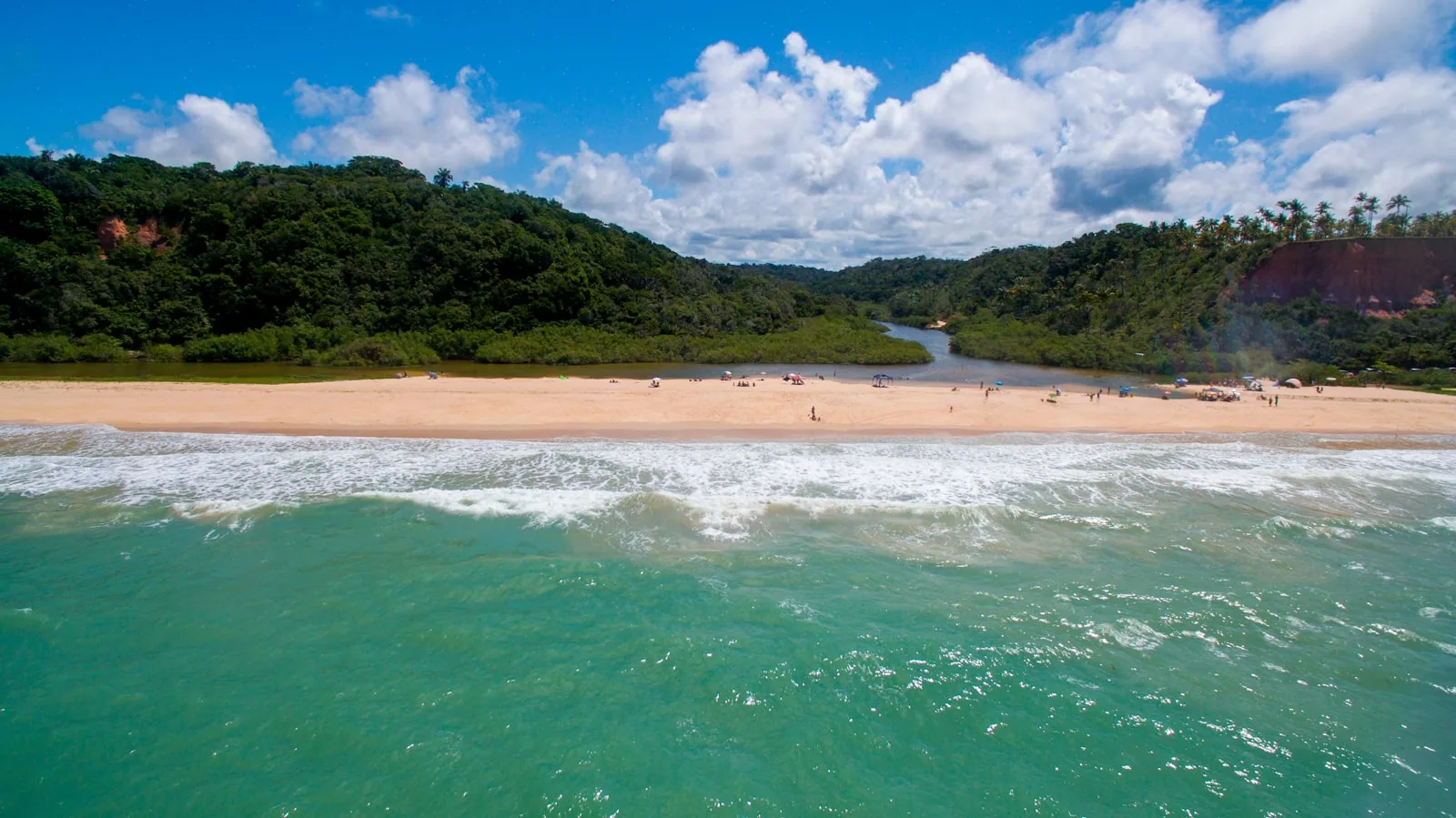
The coast around Trancoso: calm, clear water at low tide is what makes the nearby Praia do Espelho worth the drive.
3. Patacho, Alagoas
Patacho, in Porto de Pedras on the Milagres coast, is one of two Alagoas beaches on the 2026/2027 Blue Flag list, with neighboring Lage (Bandeira Azul Brasil, 2026). Expect a long, quiet arc of sand and shallow reef water.
Safety and practical note: Maceió, the usual entry airport, sees 42 mm of rain in December against 181 mm in June (Climatempo, 2026). The weak point is driving unlit coastal roads at night, so arrive in daylight. Our Maceió safety guide covers the city leg.
4. Azeda and Azedinha, Búzios
These twin coves have calm, clear water and are among five Búzios beaches on the 2026/2027 Blue Flag list, with Caravelas, José Gonçalves, Tucuns and Forno (Bandeira Azul Brasil, 2026).
Safety and practical note: Tucuns faces open sea; the west-side coves are calmer. The real high-season risk is a bag left on the sand. INEA publishes a Búzios bulletin (INEA, 2026), and our Búzios safety guide maps which coves suit families.
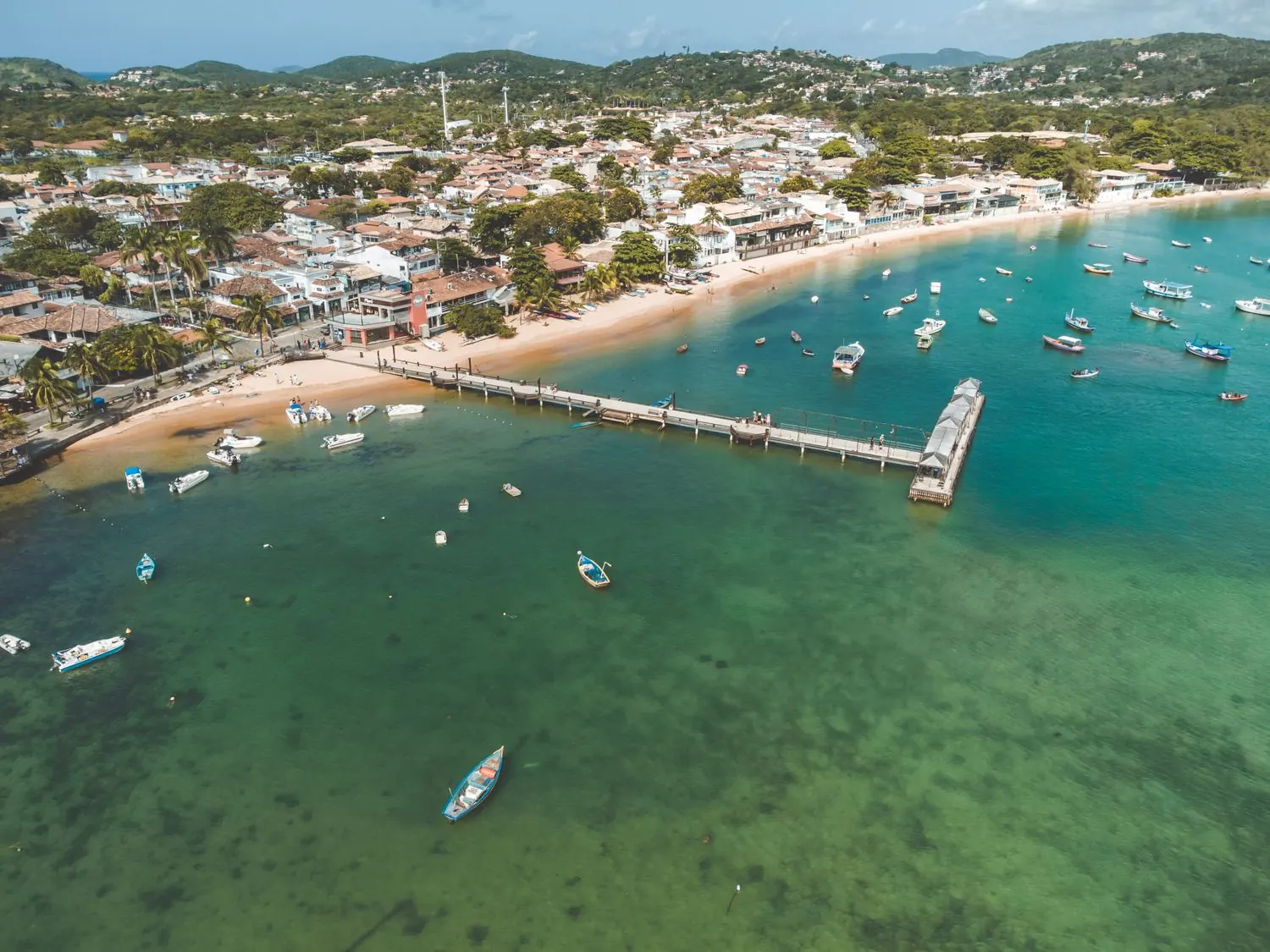
Búzios has five Blue Flag beaches in 2026/2027, the most of any municipality in Rio de Janeiro state.
5. Jericoacoara, Ceará
Jeri combines dunes, a sunset ritual on the big dune and lagoons inland. It sits inside a national park, where ICMBio charges buggy and 4x4 operators a credentialing fee of R$466 every two years (ICMBio Portaria 4423, 2025).
Safety and practical note: book buggy tours with a credentialed operator and wear the seatbelt. Fortaleza averages 7 mm of rain in September and 250 mm in April (Climatempo, 2026). Most trips route through the capital, covered in our Fortaleza safety guide.
6. Baía dos Golfinhos, Pipa
Pipa's bay is known for dolphins that often swim close to shore, below steep cliffs. The town adds a small nightlife strip and calmer water than Natal's city beaches.
Safety and practical note: cliff-foot beaches cut off as the tide rises, so check the tide table first. Natal averages 34 mm of rain in October against 187 mm in April (Climatempo, 2026). Our Natal safety guide covers the road transfer.
7. Morro de São Paulo and Boipeba, Bahia
Morro's numbered beaches run from lively to nearly empty, and Boipeba next door is quieter still. Morro is car-free, so boats and walking do the work.
Safety and practical note: take morning boats when weather builds and keep phones in a dry bag. Salvador averages 51 mm of rain in December against 187 mm in May (Climatempo, 2026). Our Bahia travel safety overview separates the coast from Salvador's statistics.
8. Prainha and Grumari, Rio de Janeiro
These beaches west of Barra are Rio's wild side: forested hills, no high-rises, and the city's only two Blue Flag beaches for 2026/2027 (Bandeira Azul Brasil, 2026).
Safety and practical note: Prainha is a surf beach, so casual swimmers should stay near lifeguard posts on big-wave days. Rio averages 37 mm of rain in July against 236 mm in January (Climatempo, 2026). Go midweek to avoid weekend parking queues.
9. Lázaro and the north coast of Ubatuba, São Paulo
Ubatuba runs from calm Lázaro to the surf at Itamambuca and the trail-access coves near Picinguaba. Water here is generally clean: on 30 October 2026, 92 of 98 CETESB points on São Paulo's north coast were suitable, against 45 of 72 around Santos (Prensa Mercosur, 2026).
Safety and practical note: read the flag before you swim and treat the remote northern coves as day trips. Our Ubatuba safety guide covers rip currents and rainy-season roads.
10. Florianópolis and Bombinhas, Santa Catarina
Florianópolis has four Blue Flag beaches in 2026/2027 (Daniela, Lagoa do Peri, Moçambique and Açores), and mainland Bombinhas, to the north, has five (Bandeira Azul Brasil, 2026). Surf beaches face east; calm bays sit in the north.
Safety and practical note: summer is the right season here despite 193 mm of January rain, because July highs drop to 19 °C (Climatempo, 2026). Check the state bulletin first, as our Florianópolis safety guide explains.
Which Brazilian beaches have a Blue Flag in 2026?
Brazil's 2026/2027 Blue Flag list names 63 beaches and 12 marinas: Santa Catarina 33 beaches, Rio de Janeiro 19, Bahia 7, Alagoas 2, Ceará 1 and São Paulo 1 (Bandeira Azul Brasil, 2026). The Instituto Ambientes em Rede runs the program in Brazil for the Foundation for Environmental Education.
Certification is annual and covers water quality, safety and services, environmental management and education (Bandeira Azul Brasil, 2026). São Francisco do Sul leads with six beaches. Bahia's seven sit near Salvador, at Guarajuba, Itacimirim, Santo Antônio in Mata de São João and Ilha dos Frades; Ceará's one is Cumbuco.
The official page lists these sites as scheduled for flag-raising, and a flag is not a daily guarantee. A certified beach can still turn unsuitable after heavy rain.
How do you check if a Brazilian beach is safe to swim?
Look up the state bathing bulletin, then read the flags on the sand. In Rio state, INEA monitors 284 points on 191 beaches, publishes results on its SEIRHI portal and advises avoiding the sea for 24 hours after heavy rain (INEA, 2026).
- Rio de Janeiro (INEA): bulletins by municipality. Since November 2026, Zona Sul and Barra-Recreio results come out on Tuesdays and Fridays, after Rio's rainiest October since Alerta Rio records began in 1997 (Diário do Rio, 2026).
- São Paulo (CETESB): weekly bulletins and a free app. A beach fails if two of its last five weekly samples exceed 100 enterococci per 100 mL, or the latest exceeds 400; green flag means suitable, red means not (Prensa Mercosur, 2026).
- Santa Catarina (IMA): a beach-by-beach lookup with blue, red and gray flags; report 54/2026 came out on 19 November 2026 (IMA, 2026).
Water quality is only half the check. Lifeguards cover about 30% of Brazil's aquatic areas, and a tourist drowns in Brazil roughly every two days (PAHO/SOBRASA, 2025). If a rip current pulls you out, swim parallel to shore before heading back in.
Our take: most lists put Noronha first and stop there. For a first Brazil trip of a week or less, we would pick Búzios or the Milagres coast instead. Seven days on Noronha cost R$672.85 in preservation fees plus the R$393 park ticket before any flight or room, and the tides decide when you reach Sancho. Noronha rewards a second trip, planned around its rules.
When is the best time to visit Brazil's beaches?
It depends on the coast. From Alagoas to Ceará, the driest stretch is September to January: Fernando de Noronha averages 21 mm of rain in November against 289 mm in April (Climatempo, 2026). The Southeast and South are warmest from December to March, also their wettest months.
So Noronha, Jericoacoara, Pipa and Alagoas shine in the second half of the year. Rio, Búzios and Ubatuba are drier from May to September but cooler, and Florianópolis is a summer destination. Christmas, New Year and Carnival fill every town on this list, so book early. Our month-by-month Brazil weather guide has the full regional calendar.
What should you pack and do on a Brazilian beach day?
Carry only what you can watch while you swim, and plan the return before sunset. Drowning claimed 5,883 lives in Brazil in 2024 (PAHO/SOBRASA, 2025), and bag theft on crowded sand is the risk our city guides flag most often.
A crossbody bag worn on the body beats a tote left on the towel when you go into the water.
- Bring a cheap phone or a waterproof pouch. A good phone on a towel is the classic soft target.
- Swim near lifeguard posts on surf beaches, and never swim alone at remote coves.
- Check the tide for Espelho, Pipa, Patacho and Sancho; access changes within hours.
- Skip the sea for a day after heavy rain, especially near storm drains and river mouths.
- Book boats and buggy tours with registered operators, not curbside offers.
The Brazil Safe Travel app gives GPS warnings about each neighborhood's risk zones and shows active alerts from other travelers, useful in beach towns where you don't know which streets empty out after dark.
Frequently asked questions
What is the most beautiful beach in Brazil?
In our ranking, Baía do Sancho on Fernando de Noronha, a cliff-backed cove inside a national marine park. The trade-off is cost: a park ticket of R$393 for foreigners from November 2026 (Brasilturis, 2026), plus the island's daily preservation fee.
Which beaches in Brazil have the cleanest water?
Start with the 63 Blue Flag beaches on the 2026/2027 list, concentrated in Santa Catarina and Rio de Janeiro state (Bandeira Azul Brasil, 2026). Then check that week's state bulletin, because water quality changes after rain even on certified beaches.
How much does it cost to visit Fernando de Noronha in 2026?
The preservation fee is R$105.79 for one day, R$423.17 for four and R$672.85 for seven (Administração de Fernando de Noronha, 2026). The park ticket is separate and valid for 10 days. Foreign credit cards pay the fee at the island's airport counter.
Is it safe to swim at beaches in Brazil?
Usually, if you check the bathing bulletin and the surf. Rio state's INEA advises staying out of the sea for 24 hours after heavy rain (INEA, 2026). On surf beaches, swim near a lifeguard post and escape a rip current by swimming parallel to shore.
What is the best beach near Rio de Janeiro?
Inside the city, Prainha and Grumari, both Blue Flag beaches for 2026/2027. For an overnight trip, Búzios has five certified beaches, including the calm Azeda and Azedinha coves (Bandeira Azul Brasil, 2026).
The bottom line
Brazil's best beaches spread across eight states, and the 63 Blue Flag beaches on the 2026/2027 list are the easiest start if clean water is your priority (Bandeira Azul Brasil, 2026). Pick the coast by season, then do the checks rankings leave out: the state bulletin, the flag, the tide, and valuables kept on your body rather than on the towel.