Is Búzios Safe? 2026 Beach Town Safety Guide

Jump to section
Updated July 2026: this guide uses the current U.S. State Department advisory for Brazil, the latest Rio de Janeiro state homicide figures, transfer and route information for the Rio–Búzios corridor, and beach-safety notes drawn from local travel sources relevant to Búzios right now.
Is Búzios safe? For most tourists, yes. Armação dos Búzios is one of the calmer, more affluent resort towns in Rio de Janeiro state, and the trip usually looks more like a beach holiday than a high-alert city visit. The wider state is trending in the right direction too: Rio de Janeiro's homicide rate fell to 20.35 per 100,000 residents in 2024, down from 21.96 the year before and the lowest total since 2015 (Rio Times Online, 2025). That state number still sits above Brazil's calmer coastal towns, but Búzios itself, a peninsula built around tourism and second homes, behaves far more gently than the raw RJ figure implies.
The official framing is worth stating plainly. The U.S. State Department keeps Brazil at Travel Advisory Level 2: Exercise Increased Caution, last reviewed in May 2025, citing crime and adding a kidnapping indicator for the country as a whole (U.S. State Department, 2025). Level 2 is the same tier applied to much of Western Europe, and it does not single out Búzios. What it means for you is ordinary, structured caution rather than fear.
If you want the country-level answer first, start with our full Brazil safety guide. If you're pairing Búzios with the city, our Rio de Janeiro safety guide shows how a very different RJ trip compares.
Key Takeaways
- Búzios is one of the safer resort towns in Rio de Janeiro state, where homicides fell to 20.35 per 100,000 in 2024, and the town's tourist areas feel calmer than that statewide figure (Rio Times Online, 2025).
- The main tourist risks are opportunistic: high-season petty theft, occasional drink-tampering around nightlife, and open-ocean surf on the east-facing beaches, not violent crime.
- The strongest setup is a pre-booked transfer or scheduled bus from Rio (about 2.5 to 3.5 hours), a base near the center or Rua das Pedras, and simple beach and night-return habits.
Is Búzios Safe for Tourists in 2026?
For most travelers, yes. Búzios reads as one of the easier beach destinations near Rio, and its risk profile is dominated by petty theft rather than violent crime. Brazil sits at Level 2: Exercise Increased Caution, the same country-wide tier applied since the May 2025 review, and that advisory does not flag Búzios specifically (U.S. State Department, 2025). The town's economy runs on tourism, so the streets you'll actually use are well-trafficked and reasonably watched.
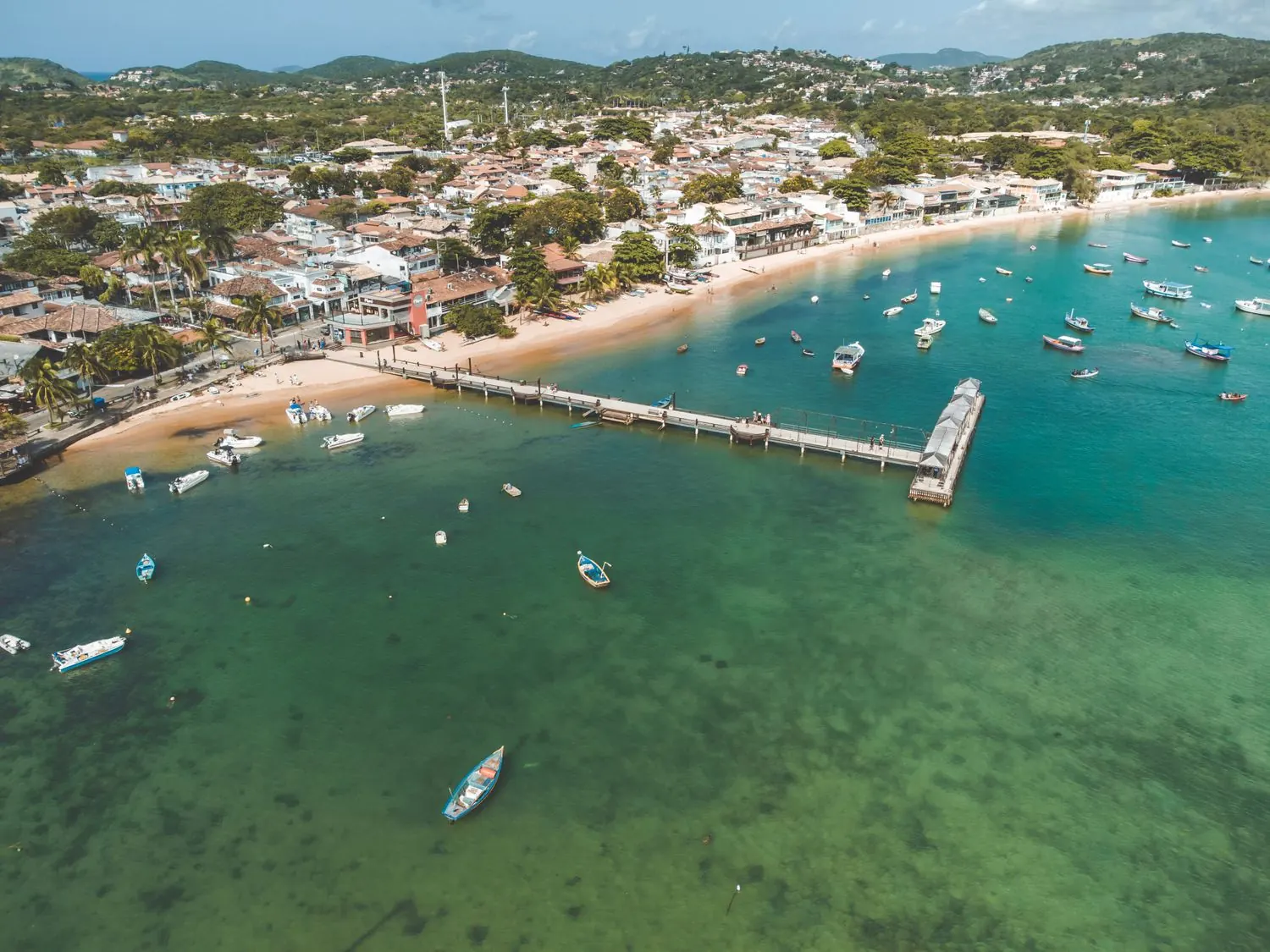
It helps to picture what Búzios is. Once a quiet fishing village, it's now an upscale peninsula with more than twenty beaches, a pedestrian dining strip, and a heavy mix of Brazilian and international visitors (South America Backpacker, 2026). That resort character is exactly why the safety conversation here is about beach logistics, seasonal crowds, and sensible night habits rather than the gang-and-favela dynamics that shape crime in parts of the Rio metro. Brazil as a whole drew a record 9.29 million international visitors in 2025, and towns like Búzios absorb a large share of the beach-holiday crowd without major incident (Jetpac Global, 2026).
None of this makes the town risk-free. High season packs the beaches and Rua das Pedras, and crowds are where opportunistic theft concentrates anywhere in Brazil. But the honest headline is that a well-planned Búzios trip is one of the lower-stress ways to enjoy the Rio de Janeiro coast.
How Safe Is Búzios Compared to the Rest of Rio de Janeiro State?
Búzios is meaningfully calmer than the state average that scares people off. Rio de Janeiro state recorded 3,504 homicides in 2024, a rate of 20.35 per 100,000 and the lowest total since 2015, continuing a multi-year decline (Rio Times Online, 2025). Nationally, violent deaths fell about 5% in 2024, so the whole country is moving in the right direction (Agência Brasil, 2025).
The key point for a Búzios visitor is that the statewide figure is skewed by the greater Rio metropolitan region, where violence clusters in specific favelas and areas of gang-police conflict (U.S. State Department, 2025). Búzios, roughly 180 km up the coast, doesn't share that geography. It's a wealthier, tourism-first municipality where the resident and visitor mix keeps the tourist corridors comparatively low-risk.

Here's how the mental comparison usually shakes out for travelers deciding where to base a Rio-state trip:
| Destination | Typical risk profile | Best for | Main caution |
|---|---|---|---|
| Búzios | Low-key resort; petty theft in season | Beaches, dining, couples, solo travelers | Crowds and phone snatching in peak summer |
| Rio city (tourist zones) | Busy, well-policed, petty theft heavy | First-time RJ, nightlife, sights | Phone theft, favela boundaries, night care |
| Rio metro periphery | Higher violent-crime areas | Not a tourist route | Avoid favelas and conflict zones entirely |
Treat this as a directional guide, not a scoreboard. The takeaway is simple: Búzios earns its reputation as one of the softer entries into the Rio de Janeiro coast, and the statewide homicide number overstates the risk you'll actually encounter on the peninsula.
What Are the Main Safety Risks in Búzios?
The risks worth planning around are opportunistic, not violent: petty theft in crowds, occasional drink-tampering near nightlife, and the usual scams that follow tourists across Brazil. Búzios is generally considered safe, but standard precautions still apply, such as not leaving belongings unattended and steering clear of poorly lit areas late at night (Visit Brasil, 2026). Statewide, the U.S. advisory notes that assaults using sedatives slipped into drinks and PIX-app "express" robberies are patterns to watch in Rio de Janeiro (U.S. State Department, 2025).
Búzios amplifies one variable in particular: season. High season runs December through March, peaking in January and February, when beaches and the town center fill with Brazilian and foreign visitors (Journey Latin America, 2026). Dense crowds are simply where casual theft concentrates, so the same beach that feels sleepy in May becomes a target-rich environment on a late-December afternoon.
The most avoidable mistakes are usually these:
- leaving a phone, bag, or wallet unattended on crowded high-season sand
- flashing expensive cameras or jewelry along Rua das Pedras at peak hours
- accepting drinks from strangers or leaving a drink unwatched during nightlife
- carrying large amounts of cash instead of paying by card
- walking long, dark, unfamiliar stretches back to a pousada instead of taking a short ride
This is where a tool like the Brazil Safe Travel app is genuinely useful: its scam and incident alerts flag the drink-tampering and PIX-robbery patterns before a night out, and its GPS risk-zone layer helps you tell a calm tourist block from a quieter area not worth wandering into after dark. For the wider playbook on the tricks that follow tourists nationwide, keep this paired with our guide to common scams in Brazil.
Is Rua das Pedras and Búzios Nightlife Safe?
Generally yes, with ordinary late-night discipline. Rua das Pedras is the pedestrian heart of Búzios, a cobbled strip of bars, restaurants, and shops that's usually described as sophisticated and safe, with clubs there and along Orla Bardot running until dawn in summer (Visit Brasil, 2026; Tripadvisor, 2026). It's busy, lit, and walkable, which is exactly the environment where a relaxed evening tends to stay uneventful.
The caution here is behavioral, not geographic. The strip's density is its charm and also the reason to keep basic drink and phone habits: don't leave a glass unattended, be wary of drinks from strangers, and keep your phone pocketed rather than face-up on a bar. The statewide advisory's note about sedative-laced drinks is the pattern to keep in mind, even though Búzios sees far less of it than the big city (U.S. State Department, 2025).
The other late-night variable is the walk home. Rua das Pedras itself stays lively, but pousadas and rentals can sit a few blocks up quieter, dimmer streets. If your bed is a long, unlit walk away, a short app-based ride is the cheap insurance. The rule of thumb: enjoy the strip, keep valuables low-profile, and don't let a good night end with an improvised walk through the darkest route back.
Are Búzios Beaches Safe?
Mostly yes, but "beach safe" in Búzios means matching the beach to your swimming ability. The peninsula has more than twenty beaches, and they split cleanly by exposure: the west-coast beaches offer calm, clear water, while the east-coast beaches face the open Atlantic and run wilder, drawing surfers and stronger swimmers (South America Backpacker, 2026). That geography is the single most useful thing to understand before you pick where to swim.
For calm water and easy family days, the sheltered coves like Azeda, João Fernandes, and Ferradura tend to be the reliable choices, with Armação right in town for convenience (Visit Brasil, 2026). The open-sea beaches are beautiful but carry real surf and rip-current potential, the same as any Atlantic-facing coast. The standard ocean-safety advice applies: if you're caught in a rip, don't fight it, swim parallel to shore until you're out of the pull, then angle back in, and favor beaches with visible lifeguard coverage when the surf is up.
Here's the quick mental split most visitors use:
| Coast | Water | Good for | Watch for |
|---|---|---|---|
| West-side coves (Azeda, João Fernandes, Ferradura) | Calm, clear, sheltered | Families, weaker swimmers, snorkeling | Crowds and belongings in peak season |
| East-facing open beaches (Geribá, Tucuns) | Real Atlantic surf | Surfers, confident swimmers | Rip currents, stronger waves |
| In-town (Armação, Ossos) | Mixed, convenient | Quick swims, sunset walks | Petty theft where crowds gather |
The practical crossover with crime is the same everywhere in Brazil: a beach bag left alone while you swim is the classic soft target. Bring only what you can watch, keep phones tucked away, and the beach day stays about water and sun rather than a lost wallet.
Is Getting to Búzios from Rio Safe?
Usually yes, and the safest arrival is the one you decide before you leave Rio. Búzios sits about 180 km from downtown Rio de Janeiro, and the trip runs roughly 2.5 to 3.5 hours depending on traffic in the Região dos Lagos (Rome2Rio, 2026). You have three sensible options: a scheduled long-distance bus, a private or shared transfer, or a rental car.
The bus is the budget backbone. Auto Viação 1001 runs the Rio–Búzios route from the Novo Rio bus terminal in Rio, with frequent daily departures and tickets in the roughly US$13–35 range (Bookaway, 2026). It's a reliable, well-worn tourist route. The main safety note is the Novo Rio terminal itself, which, like any big-city bus station, is a place to keep bags close and valuables secured. A private transfer costs more but drops you door-to-door and removes the terminal-and-taxi shuffle entirely, which many first-timers find worth it.

Timing matters as much as mode. On peak-season weekends and holidays, the Rio-Niterói Bridge and the Via Lagos toll road bottleneck badly, especially Friday afternoons and Saturday mornings, so locals suggest leaving before 8 a.m. or after 8 p.m. to skip the worst of it (Rome2Rio, 2026). If you're driving yourself, that's a longer haul on unfamiliar roads, and our guide on whether it's safe to drive in Brazil covers the tolls, night-driving, and rental logistics you'll want to weigh first. For picking your travel window overall, see our best time to travel to Brazil guide.
Is Búzios Safe for Solo and Female Travelers?
For many, yes, and Búzios consistently lands among the more comfortable Brazilian beach towns for independent travel. One community safety index ranks Búzios among the safer places in Brazil for solo female travelers, with a middling-to-decent overall score reflecting its resort character rather than any acute danger (Travel Ladies, 2026). The compact town center, the walkable dining strip, and the density of small pousadas make it easy to build a self-contained, low-friction trip.
The practical setup solo travelers describe is a guesthouse near Búzios centro or within reach of Rua das Pedras, which keeps the daily loop, sleep, beach, dinner, short and legible (CORR Travel, 2026). That compactness is a real safety asset: shorter distances mean fewer long, dark walks and less reliance on unfamiliar late-night transport. The same habits that serve anywhere in Brazil apply here, just with a lighter background risk. Our dedicated guide on whether Brazil is safe for solo female travelers, families, and LGBTQ visitors goes deeper on the country-wide picture.
The nightlife caveat is the one to carry: the same drink-and-phone discipline covered above matters most for anyone out alone. Keep a drink in view, share your plans with your accommodation, and default to a short ride over a long solo walk when the streets thin out. Do that, and Búzios is one of the easier places in the country to travel independently.
What Should You Do If Something Goes Wrong in Búzios?
Move fast and procedurally; a resort town makes recovery easier because the environment is calm and tourist-facing. Because petty theft is the dominant risk rather than violent crime, most incidents here are the recoverable kind, provided you handle them in the right order rather than freezing or improvising on the street (Visit Brasil, 2026).
If something goes wrong:
- get into a controlled indoor space, a hotel lobby, restaurant, or shop
- lock your cards, phone access, and PIX/banking apps immediately
- call
190for police if there's an active threat, or192for medical emergencies - file a police report so you have documentation for insurance and card replacement
- contact your consulate if documents are lost or the situation escalates
This is also where the Brazil Safe Travel app earns its place for visitors who don't speak Portuguese. Its emergency Portuguese audio can play a clear request for police or medical help to staff or bystanders, removing the language friction that turns a small incident into a stressful one, while its incident alerts keep the current scam patterns top of mind before a night out rather than after. For the essential numbers to save before you go, keep this paired with our Brazil emergency numbers guide.
Frequently Asked Questions
These are the questions travelers ask most once the broad Brazil safety question narrows to one upscale beach town and a practical summer itinerary.
Is Búzios safe for tourists?
Yes, for most travelers. Búzios is one of the calmer resort towns in Rio de Janeiro state, where homicides fell to 20.35 per 100,000 in 2024, and the town itself feels gentler than that. The main risks are high-season petty theft and ordinary nightlife caution, not violent crime.
Is Búzios safer than Rio de Janeiro city?
In practical terms, yes. Búzios lacks the favela-boundary and gang-conflict dynamics that shape violent crime in parts of the Rio metro. Both places share petty-theft risk, but Búzios is a tourism-first peninsula about 180 km up the coast, so its tourist areas feel lower-key than the city's.
Is Rua das Pedras safe at night?
Generally yes. The strip is busy, well-lit, and usually described as sophisticated and safe, running until dawn in summer. Keep drinks in view, don't accept drinks from strangers, and take a short ride if your accommodation is a long, dark walk away rather than walking unfamiliar quiet streets alone.
Are Búzios beaches safe to swim?
It depends on the coast. West-side coves like Azeda and João Fernandes are calm and family-friendly, while east-facing beaches like Geribá face the open Atlantic with real surf and rip currents. Match the beach to your swimming ability, and never leave belongings unattended while you're in the water.
How do I get from Rio to Búzios safely?
The route runs about 180 km and 2.5 to 3.5 hours. A scheduled 1001 bus from the Novo Rio terminal costs roughly US$13–35, or a private transfer goes door-to-door for more. Travel outside peak weekend traffic windows, and keep valuables secured at the Rio bus terminal.
Búzios is one of the more reassuring answers on the Rio de Janeiro coast: an upscale, tourism-first beach town where the statewide crime numbers overstate the risk you'll actually meet, and where most of what remains is ordinary beach-resort caution. The strongest version of the trip is the simple one, a pre-arranged transfer or well-timed bus, a base near the center, west-side coves when you want calm water, and light discipline around summer crowds and nightlife. For the wider country view, go back to our full Brazil safety guide, and if you're combining the coast with the city, read it alongside our Rio de Janeiro safety guide and the practical tricks in common scams in Brazil.