Brazil Trip Cost 2026: Daily Budget in US$ and R$

Jump to section

Rio from above: the beach is free, while Christ the Redeemer and Sugarloaf, both in this view, are the two biggest ticket lines in a Rio budget.
Updated November 2026. This guide prices a Brazil trip for American travelers using official 2026 fares, the Banco Central exchange rate and the costs most budget guides skip.
A Brazil trip costs most Americans roughly US$1,350 to US$2,300 per person for a mid-range week, flight included, by our estimate. On the ground, a mid-range day in Rio runs about R$410 to R$705 (US$69 to US$118). The dollar also goes far right now: Banco Central do Brasil's PTAX rate closed at R$5.97 per US dollar on November 23, 2026 (Banco Central do Brasil, 2026).
So is Brazil expensive? Not for daily spending. The flight, the eVisa and the December to March peak are what move the total, along with a few fees tourists rarely see coming. Every price below is tied to the operator or agency that sets it, and every total is labeled as our estimate.
Key Takeaways
- The dollar bought R$5.97 on November 23, 2026, up from R$5.39 a year earlier, while Brazilian inflation ran at 4.63% over the 12 months to October (BCB; IBGE, 2026).
- Brazil's overall price level is roughly 46% of the US level, by our calculation from World Bank 2025 data. A Big Mac cost US$4.71 in Brazil against US$6.22 at home in July 2026 (The Economist).
- A mid-range day in Rio costs about R$410 to R$705 per person, built from official fares such as the R$7.90 metro ride and the R$139 Christ the Redeemer train.
- Fixed costs: the US$80.90 eVisa, a round-trip flight that typically runs US$580 to US$1,650 from New York, and insurance at 4% to 10% of prepaid trip costs.
Is Brazil expensive for Americans in 2026?
No. On The Economist's Big Mac index, a Big Mac cost R$23.90 in Brazil in July 2026, or US$4.71, against US$6.22 in the United States, a 24% discount (The Economist, 2026). At November's exchange rate the same burger works out to about US$4.00.
The broader measure points the same way. The World Bank's 2025 purchasing-power factor for Brazil was R$2.55 per international dollar, while the average market rate that year was R$5.59 (World Bank, 2025). Divide one by the other and Brazil's price level comes out near 46% of the US level: a dollar spent locally goes about twice as far.
The exchange rate has also moved in the traveler's favor. PTAX rose from R$5.20 per dollar on July 1, 2026 to R$5.97 on November 23, and a year earlier it stood at R$5.39 (Banco Central do Brasil, 2026). Prices in Brazil rose more slowly: the IPCA consumer price index climbed 4.63% in the 12 months to October 2026 (IBGE, 2026).
| Indicator | Latest figure | Source, year |
|---|---|---|
| US dollar to Brazilian real (PTAX) | R$5.97 (Nov 23, 2026) | Banco Central do Brasil, 2026 |
| Same rate a year earlier | R$5.39 (Nov 24, 2025) | Banco Central do Brasil, 2025 |
| Inflation, 12 months (IPCA) | 4.63% (to Oct 2026) | IBGE, 2026 |
| Big Mac, Brazil vs US | US$4.71 vs US$6.22 (Jul 2026) | The Economist, 2026 |
| Overall price level vs US | About 46% (2025) | Our calculation, World Bank data |
Combine the exchange rate and inflation figures and a dollar buys roughly 6% more in Brazil than a year ago, after local inflation (our calculation from BCB and IBGE figures). That cushion can vanish fast: the rate went from R$5.56 to R$5.97 in under two weeks this November, so recheck it before large payments.
How much does a trip to Brazil cost per day?
A day in Rio costs about R$200 to R$380 (US$34 to US$64) on a budget, R$410 to R$705 (US$69 to US$118) mid-range, and R$935 to R$1,650 (US$157 to US$276) in comfort, per person, by our estimate. The fixed points are official: a MetrôRio ride costs R$7.90 (MetrôRio, 2026) and the Corcovado train R$139.
| Per person, per day | Budget | Mid-range | Comfort |
|---|---|---|---|
| Bed (assumption, varies by season) | R$80–150 (hostel bed or simple pousada) | R$150–275 (half a double room) | R$400–700 (half a double room, upscale) |
| Food | R$100–130 | R$150–210 | R$250–400 |
| Local transport | R$20–30 (metro and bus) | R$40–80 (metro plus 1–2 rides) | R$80–150 (rides everywhere) |
| Sights | R$0–70 | R$70–140 | R$205–400 |
| Daily total (our estimate) | R$200–380 | R$410–705 | R$935–1,650 |
| In US dollars at R$5.97 | US$34–64 | US$69–118 | US$157–276 |
The metro fare has been frozen at R$7.90 by state decree since April 12, 2026, and Rio's city buses went from R$4.70 to R$5.00 on January 4, 2026 (Brasil de Fato, 2026). Two metro rides and two bus rides make the R$26 budget day.
Food prices come from Numbeo's crowdsourced Rio data, updated November 20, 2026, since no official body publishes restaurant prices. It puts a meal at an inexpensive restaurant at R$45 and a three-course dinner for two at a mid-range place at R$205 (Numbeo, 2026). The same page lists a taxi flag fall of R$6.30 plus R$3.85 per kilometer, so a 5 km ride runs about R$25. Read those as midpoints.
The sights row uses the two big Rio tickets. The Trem do Corcovado charges R$139 for an adult of any nationality, covering the round trip and access to the Christ the Redeemer monument (Trem do Corcovado, 2026). The Sugarloaf cable car starts at R$205 (Parque Bondinho Pão de Açúcar, 2026). Beaches, hikes and most viewpoints cost nothing.

Christ the Redeemer: the Corcovado train ticket is R$139 for an adult in 2026, one of the largest single line items in a Rio day.
Beds are the one row with no official price. Rio's hotel rates swing with season, neighborhood and events, so treat that row as a planning assumption. Check live rates for your dates, and use our neighborhood-by-neighborhood guide to hotels in Rio de Janeiro to see where a higher rate actually buys you something.
What do flights, the eVisa and insurance add?
Fixed costs usually exceed a week of mid-range spending. Google Flights shows typical round-trip economy fares of US$580 to US$840 from New York to Rio in January, the cheapest month on its data, and US$870 to US$1,650 in December, the most expensive (Google Flights, 2026).
Flights
From Miami, the same data shows US$540 to US$950 in January and US$900 to US$1,600 in December (Google Flights, 2026). Typical New York fares run US$730 to US$1,250 on American, the range we use for the sample totals below. Our comparison of routes and airlines from the US to Rio covers which hubs and connections tend to price lower.
The eVisa
US citizens pay US$80.90 for the Brazilian eVisa, which covers stays of up to 90 days and is applied for online (Consulate General of Brazil in Miami, 2026). It must be approved before you board, and the application steps are in our guide to whether American citizens need a visa for Brazil.
Travel insurance
Full trip-protection plans typically cost 4% to 10% of your prepaid, non-refundable trip costs, and Squaremouth's data puts the average 2026 policy at US$314 for an average trip of 15 days (Squaremouth, 2026). On a US$1,000 flight plus US$500 of prepaid hotels, that rule of thumb means US$60 to US$150. Our travel insurance guide for Brazil explains which coverage limits matter there.

The flight is usually the biggest single cost of a Brazil trip, and the month you fly changes it more than the airline does.
Which hidden costs push a Brazil budget up?
Four costs catch Americans: their own card's foreign transaction fee, ATM charges, the 10% restaurant service charge and peak-season pricing. Brazil's 3.5% IOF tax, often listed as a tourist cost, is set by Decree 12,499 of June 2025 for Brazilian card issuers' customers spending abroad (Presidency of Brazil, 2025).
Your card's foreign transaction fee
That decree taxes Brazilians using Brazilian cards outside the country, so it is not a line on a US card statement. What a US card can add is a foreign transaction fee, and charges stack: the CFPB's own Regulation Z commentary uses the example of a 1% network charge plus a 2% issuer charge, a 3-point fee in total (Consumer Financial Protection Bureau, 2026). A card with no foreign transaction fee removes it. When a terminal offers to charge you in dollars, choose reais, because the conversion it offers is the merchant's, not your bank's.
ATM fees
Brazilian ATMs can charge a per-withdrawal fee that appears on screen before you confirm, and your US bank may add its own out-of-network and foreign fees on top. Fewer, larger withdrawals keep fixed charges down; use machines inside bank branches or malls, in daylight. Our guide to paying in Brazil with cards, cash and Pix covers which method to use where.
The 10% service charge
Most sit-down restaurants add a 10% taxa de serviço to the bill. It is a tip, and Procon, Brazil's consumer protection agency, says paying it is the customer's choice (Procon Porto Alegre, 2019). Budget for it anyway: on a R$205 dinner for two, it adds R$20.50. Check the bill before tipping again on top.
Peak season and Carnival
December is the most expensive month to fly on Google's New York and Miami data, and Carnival fills hotels. HotéisRIO projected 83.7% hotel occupancy across Rio for Carnival, February 14 to 17, 2026 (Agência Brasil, 2026). Carnival 2027 comes early, with Carnival Tuesday on February 9, so a February trip needs to be priced months out. Our month-by-month guide to the best time to travel to Brazil weighs price against weather.
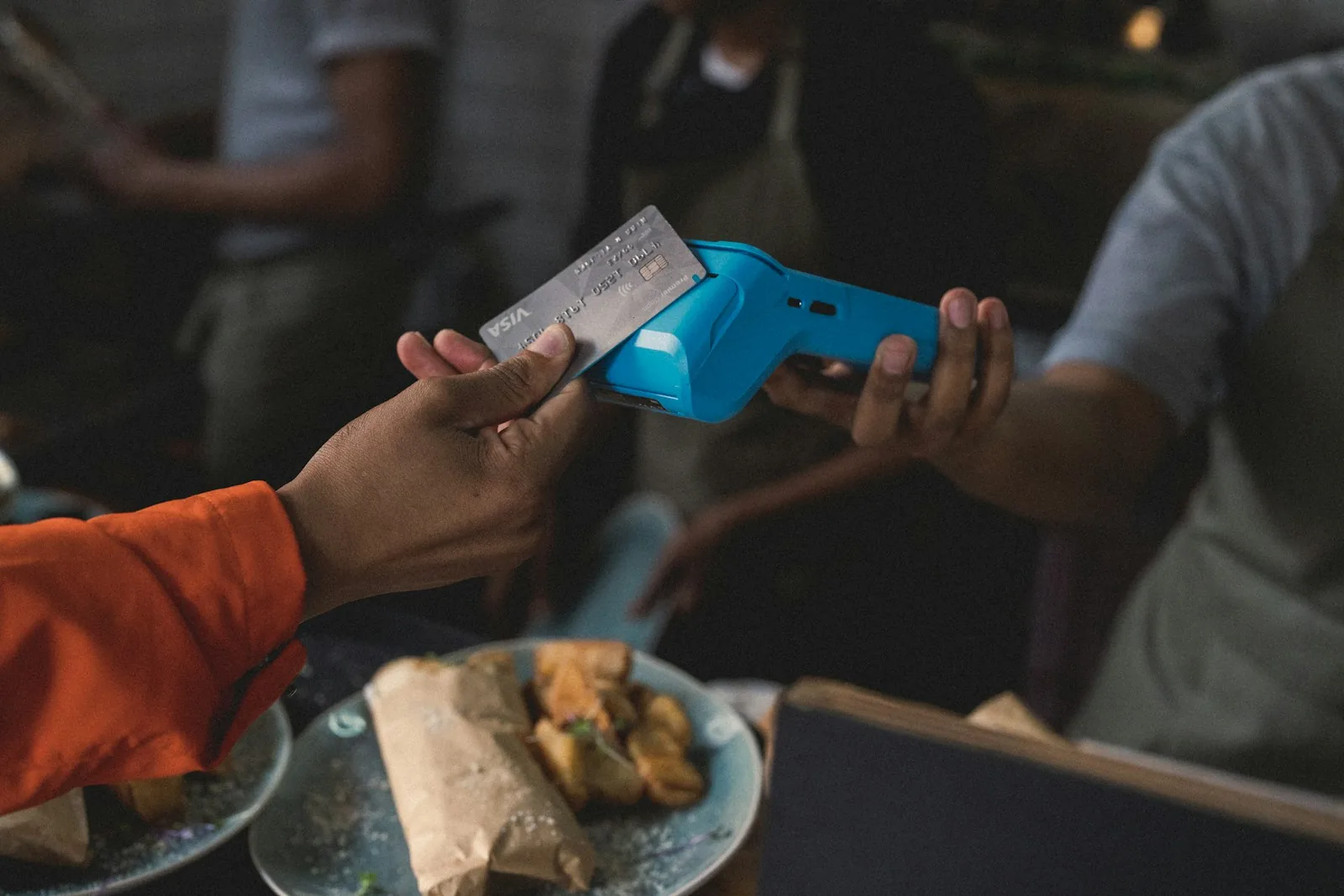
Contactless cards work almost everywhere in Brazil; the cost to watch is your own bank's fee and the amount typed into the machine.
One hidden cost is not a fee at all: card-machine overcharges, where a vendor keys a larger amount into a screen you can't see. The Brazil Safe Travel app sends scam warnings for the area you're in, alongside GPS warnings about each neighborhood's risk zones.
How much does a 7- or 10-day trip to Brazil cost?
By our estimate, a mid-range week in Brazil costs about US$1,350 to US$2,300 per person, and 10 days about US$1,550 to US$2,700. Both include a US$730 to US$1,250 round-trip flight, the US$80.90 eVisa and insurance at 4% to 10% of flight and lodging. Budget and comfort travelers land on either side.
| Per person, flight included (our estimate) | Budget | Mid-range | Comfort |
|---|---|---|---|
| 7 days in Brazil | US$1,100–1,900 | US$1,350–2,300 | US$1,950–3,450 |
| 10 days in Brazil | US$1,200–2,100 | US$1,550–2,700 | US$2,450–4,350 |
These totals assume one base city at Rio prices and R$5.97 per dollar, with no domestic flights. If you follow our 7- and 10-day routes through Rio, Iguazu and Salvador, add one domestic fare per hop, and price those on the same day you price the international flight.

Lodging is the row that separates the three columns: food and transport barely change between budget and mid-range.
The low end of each range is a January or shoulder-season trip; the high end is closer to December fares. If you would rather pay one price up front, compare these figures line by line against packaged Brazil trips, checking whether insurance and transfers are included.
Our take: don't treat Christ the Redeemer and Sugarloaf as small extras. Together the two tickets cost R$344, about US$58 at November's rate, which is nearly a full budget-tier day. And if you are choosing where to save, save on food rather than location: a R$45 lunch is genuinely cheap in Rio, while a room far from the Zona Sul adds a paid ride every evening and quietly erases the discount.
How to keep your Brazil travel budget in check
Three decisions set most of a Brazil travel budget before you land: travel dates, how you pay and how many cities you add. Dates alone can move a New York round trip by more than US$1,000, the gap between January's typical low of US$580 and December's high of US$1,650 (Google Flights, 2026).
- Fly outside December and Carnival. On the data above, January and the shoulder months are where the low-end totals come from.
- Pay in reais with a no-foreign-fee card. Decline any offer to charge in dollars, at terminals and at ATMs alike.
- Ride the metro by day. At R$7.90 a ride, it is the cheapest way across the Zona Sul and Centro; save taxis and ride-hailing for night.
- Buy the big tickets from the official operators. The Corcovado train and the Sugarloaf cable car both sell online, at the R$139 and R$205 prices cited above.
- Sort mobile data before you fly. Maps, ride-hailing and banking apps all need it on arrival, and our eSIM guide for Brazil compares the options.
- Keep the city count low. Each extra stop adds a domestic flight and a day lost to transfers.
Frequently asked questions
How much money do I need for a week in Brazil?
For a mid-range week based in Rio, plan on about R$2,900 to R$4,900 per person for spending on the ground, or US$480 to US$830 at R$5.97 per dollar (our estimate from the daily table). Flights, the US$80.90 eVisa and insurance come on top, for a total of about US$1,350 to US$2,300.
Is Brazil cheap for Americans right now?
For daily spending, yes. Brazil's price level is roughly 46% of the US level (our calculation, World Bank 2025 data), and the dollar bought R$5.97 on November 23, 2026, against R$5.39 a year earlier (Banco Central do Brasil). The flight is the part that is not cheap.
Do I have to pay the 10% service charge in Brazil?
No. The taxa de serviço on most restaurant bills is a tip, and Procon says paying it is the customer's choice (Procon Porto Alegre, 2019). Most diners pay it when service was fine; just don't tip twice.
How much is the Brazil eVisa for US citizens?
US$80.90, paid online, for stays of up to 90 days (Consulate General of Brazil in Miami, 2026). Apply before booking anything non-refundable.
When is the cheapest time to fly to Brazil from the US?
On Google Flights data for New York and Miami to Rio, January is typically the cheapest month and December the most expensive. Typical January round trips run about US$540 to US$950, against roughly US$870 to US$1,650 in December (Google Flights, 2026).
The bottom line on Brazil trip costs
Brazil is inexpensive once you arrive. The metro is R$7.90, an inexpensive lunch is about R$45, and the dollar bought R$5.97 in late November 2026. What makes a Brazil trip cost more is concentrated in a few lines: the flight month, the eVisa, insurance, your card's fees and how many cities you try to fit in.
Price those first, then build the daily budget around the column that matches how you travel, and recheck the exchange rate before you go.