eSIM Brazil: Best Way to Stay Connected (2026 Guide)

Jump to section
Salvador, Bahia — Brazil's 5G network now covers all state capitals, so an eSIM keeps you online across most tourist routes.
Updated July 2026. This guide explains how to get online in Brazil, why an eSIM usually beats a physical SIM for tourists, which providers are worth it, and how staying connected is also a safety decision.
Will your phone work in Brazil the second you step off the plane? It can — but only if you sort out data before you fly. Brazil runs one of the largest mobile markets on the planet, with more than 250 million mobile connections for a population of about 203 million (Anatel, 2025; CDC Yellow Book: Brazil, 2025). The infrastructure is there. The problem for foreigners is almost never signal. It's paperwork.
That's where the eSIM changes everything. It removes the single biggest friction point tourists hit at a Brazilian phone shop, and it does it before you even leave home.
If you're still assembling the wider trip, start with our guide on whether Brazil is safe to travel to, where connectivity fits into a broader packing and safety plan.
Key Takeaways
- Brazil's regulator, Anatel, lets tourists activate a SIM with just a passport, but physical stores often demand a CPF (Brazilian tax ID) foreigners don't have — an eSIM skips that problem entirely.
- Brazil has 5G in all 26 state capitals plus Brasília, and three national carriers (Vivo, Claro, TIM), so city coverage is strong for most tourist routes.
- An eSIM is bought online, delivered as a QR code, and works on arrival. Keep a physical SIM as a backup for older phones or long stays.
Is eSIM available in Brazil?
Yes. eSIM is fully supported in Brazil, and all three national carriers — Vivo, Claro, and TIM — run eSIM-capable 5G networks that reach every state capital (Anatel, 2025). For a tourist, that means you can land in Rio, São Paulo, Salvador, or Recife and connect to a local network in minutes, without ever visiting a store. The eSIM is a digital SIM built into your phone, activated by scanning a QR code instead of inserting a plastic chip.
The catch is your device, not the country. eSIM only works on phones that ship with the hardware: iPhone XS, XR, and every model since (2018 onward), Google Pixel 3 and newer, and Samsung's Galaxy S20 line and up. If your phone is older than that, the technology simply isn't there, and you'll need a physical SIM instead.
Here's the part travelers underestimate. An eSIM isn't just convenient — it's the cleanest way around Brazil's biggest connectivity headache for foreigners. You buy it from a provider's app or website, often before your flight, and the local data is live the moment your plane's doors open. No queue at the airport kiosk, no language barrier at a counter, no CPF.
Do you need a CPF to buy a SIM card in Brazil?
Legally, no. Anatel established back in 2012 that foreign visitors can buy and activate a Brazilian SIM using only a passport (Anatel, 2012). In practice, though, this is where thousands of tourists get stuck every year. Store employees frequently ask for a CPF — the Brazilian individual taxpayer number — because their registration systems default to it and staff may not know the passport option exists.
The CPF gap is the single most common reason a Brazil SIM purchase goes sideways. You walk into a Claro or Vivo shop, hand over your passport, and the clerk stalls at the CPF field. Some travelers get lucky with a helpful employee; others get turned away, or the SIM activates but never fully registers, leaving them with a dead chip.
This is exactly why an eSIM wins for most visitors. Tourist-focused eSIM providers don't touch the Brazilian CPF system at all — you register with your passport details online, and activation happens on the provider's own network deal. TIM is generally the most passport-friendly carrier for those who still want a physical chip, selling starter SIMs for roughly R$25 (about US$4) plus a small activation fee, but the eSIM avoids the counter entirely.
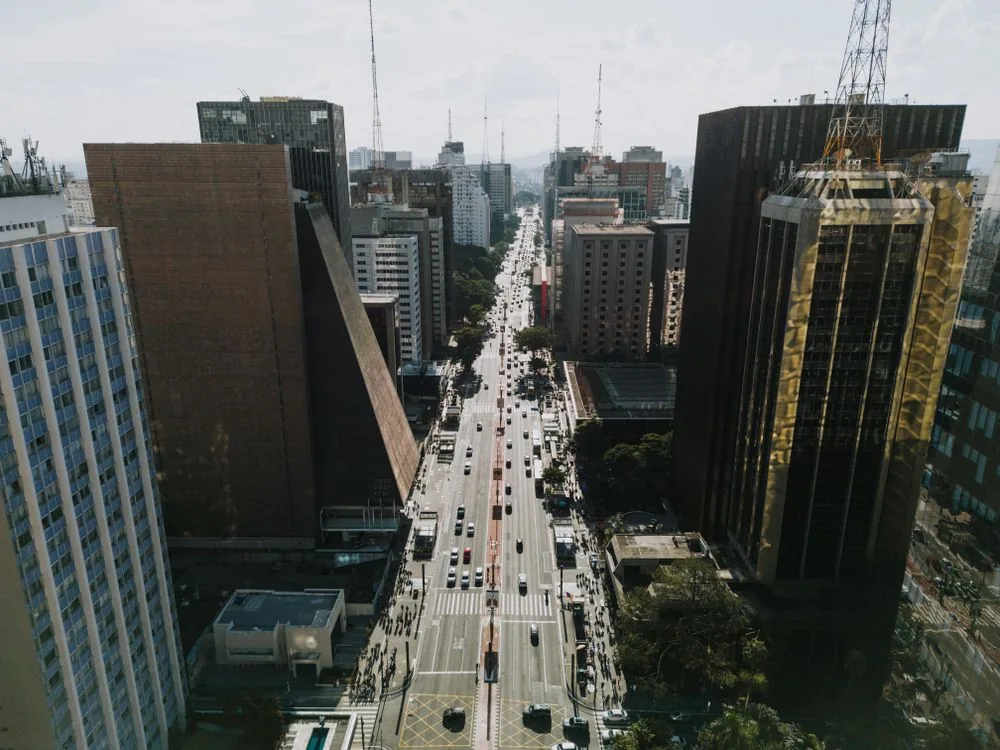
São Paulo's business districts have among Brazil's densest 5G coverage, ideal for eSIM data from the moment you land at Guarulhos.
eSIM vs SIM card for Brazil: which should you choose?
For most tourists on a city-based trip, an eSIM is the better choice, mainly because it removes the CPF barrier and works instantly on arrival. A physical SIM still has its place — older phones, very long stays, or travelers who want a local Brazilian phone number all point toward the plastic chip. The right answer depends less on price and more on your device and trip length.
The two options solve the same problem in different ways. An eSIM is fast, remote, and paperwork-free, but locked to newer phones. A physical SIM works on any unlocked handset and can be cheaper for heavy, long-term data use, but it means finding a store, clearing the CPF hurdle, and swapping out your home SIM.
| Factor | eSIM | Physical SIM Card |
|---|---|---|
| Setup | Online before you fly; scan a QR code | Buy in-store or at the airport on arrival |
| CPF required? | No — passport details online only | Officially no, but stores often ask |
| Works on arrival? | Yes, instantly | Only after you find and visit a shop |
| Phone compatibility | iPhone XS+, Pixel 3+, Galaxy S20+ | Any unlocked phone |
| Local phone number | Usually data-only | Yes, a Brazilian number |
| Best for | Short-to-mid city trips, convenience | Older phones, long stays, local number |
| Keeps your home SIM active | Yes — dual SIM | No — you swap the chip out |
If you're also sorting out chargers and plugs for the trip, our Brazil travel adapter guide covers the Type N plug and dual voltage you'll need to keep that phone charged.
What is the best eSIM for Brazil?
There's no single "best" eSIM — the right pick depends on how long you're staying and how much data you burn. The main tourist-focused providers all cover Brazil's networks reliably: Airalo, Holafly, Saily, and aloSIM are the names that come up most, and they piggyback on the same Vivo, Claro, and TIM infrastructure that carries local subscribers (Anatel, 2025). The difference between them is pricing structure, not signal quality.
The real decision is data model. Some providers sell fixed data buckets (say, 5 GB over 30 days), while others offer unlimited plans capped at a daily "fair use" speed. For a photo-and-maps traveler, a fixed 5–10 GB bucket is usually plenty. For someone streaming, tethering a laptop, or making constant video calls, an unlimited plan removes the anxiety of running dry mid-trip.
The most common mistake isn't picking the "wrong" brand — it's underbuying data. Maps, rideshare apps, translation tools, and constant messaging chew through more than people expect, especially when you're navigating an unfamiliar city every day. It's cheaper to start with a slightly bigger plan than to top up in a panic while lost in a neighborhood you don't know.
How much data do you need for a Brazil trip?
Most tourists comfortably get by on 1 to 1.5 GB per day, which covers maps, rideshare, messaging, social media, and light browsing without much rationing. Over a typical 10-day trip, that lands around 10–15 GB. Heavy users who stream video, tether a laptop, or make frequent video calls should budget closer to 2–3 GB a day, or simply choose an unlimited plan to stop counting.
Your biggest data drains in Brazil are predictable: Google Maps or Waze running constantly as you navigate, Uber and 99 (Brazil's main rideshare apps), WhatsApp — which is the default messaging and even booking channel across Brazil — and translation apps. Streaming and photo backups are the wild cards that push usage up fast.
Here's a rough planning guide by traveler type:
- Light user (maps, messaging, occasional browsing): ~1 GB/day, or 8–10 GB for a 10-day trip.
- Standard tourist (maps, rideshare, social media, photos): ~1.5 GB/day, or 12–15 GB for 10 days.
- Heavy user (streaming, tethering, video calls): 2–3 GB/day, or an unlimited plan.
- Two-week-plus stay: consider a physical SIM or a larger eSIM bundle for better per-GB value.
If your itinerary hops between several cities, our Brazil travel destinations guide helps you map the route before you size your data plan.
Does Brazil have good 5G and network coverage?
Brazil's 5G coverage is strong in cities and thin in the wild, which is the whole point of planning by route. The country switched on commercial 5G in 2022 and has since extended it to all 26 state capitals plus the Federal District of Brasília, with the three carriers competing hard on urban speed (Anatel, 2025). For the cities where most tourists actually spend time — Rio, São Paulo, Salvador, Recife, Fortaleza, Foz do Iguaçu — connectivity is genuinely good.
Coverage falls off exactly where you'd expect. The Amazon basin, the Pantanal wetlands, and remote stretches of highway can drop to weak 4G or no signal at all. That's not a carrier failure; it's geography. Brazil is continental in scale, and no eSIM changes the fact that a boat trip up an Amazon tributary won't have bars.
For a city itinerary, all three carriers perform well, so the eSIM provider's underlying network matters less than you'd think. For a nature-heavy route, the smarter move is to download offline maps and any critical apps before you leave the city — including the Brazil Safe Travel app, whose GPS risk-zone maps and offline scam alerts are most useful precisely when signal gets patchy.

Rio's Zona Sul — from Copacabana to Ipanema — has dependable 5G, so an eSIM keeps maps and rideshare running along the tourist corridor.
Why staying connected in Brazil is a safety decision
Getting online isn't just about convenience in Brazil — it's a core safety habit. Official U.S. guidance points travelers toward a Level 2 "exercise increased caution" posture for Brazil, and a working data connection underpins nearly every recommended precaution, from using app-based transport to avoiding sketchy street-side improvisation (U.S. Embassy in Brazil, 2026). A dead phone at the airport is how a lot of avoidable problems start.
Think about the first hour after landing. With live data, you order an Uber or 99 from inside the terminal, watch the route on the map, and skip the informal taxi touts that overcharge new arrivals. Without data, you're negotiating a fare in a language you may not speak, with no way to verify the price or the route. Connectivity turns a risky transition into a routine one.
This is the strongest case for setting up an eSIM before you fly rather than after you arrive. The riskiest moments — airport exits, first-night navigation, late arrivals — are exactly when you most need a phone that already works. An eSIM active on landing means maps, rideshare, translation, and the Brazil Safe Travel app's emergency features (including its Portuguese emergency audio) are ready before you clear customs, not an hour later.
For the specific tricks to watch for once you're online, read our guide to common scams in Brazil, and if Rio is on your itinerary, the Rio de Janeiro safety guide goes deeper on phone theft and neighborhood movement.
How do you set up an eSIM for Brazil?
Setting up a Brazil eSIM takes about five minutes and is best done before you fly, over your home Wi-Fi. The process is the same across the main providers: buy the plan online, receive a QR code by email or in the provider's app, then add it to your phone through the cellular settings. Crucially, installing the eSIM does not activate the data — most plans start their clock when you first connect in Brazil, so you can set it up early without wasting days.
Follow this order to avoid the two mistakes that trip people up:
- Confirm your phone is eSIM-compatible and carrier-unlocked before buying (iPhone XS+, Pixel 3+, Galaxy S20+).
- Buy the plan and scan the QR code at home, on Wi-Fi, so any error gets solved before departure.
- Label the line (e.g., "Brazil Data") and set your home SIM to stay active for calls and texts if you want dual SIM.
- Turn on data roaming for the eSIM line only once you land — this sounds wrong, but "roaming" is how the eSIM connects to the local Brazilian network.
- Set the eSIM as your default data line and keep your home number for authentication codes.
The single most common error is forgetting to enable data roaming on the eSIM line, then assuming the plan is broken. It isn't — that toggle is what tells your phone to use the Brazilian network. The second is buying too small a plan, which we covered above.
If you're timing your trip around season and crowds, pair this with our best time to travel to Brazil guide so your data plan matches your travel dates.
Frequently Asked Questions
These are the connectivity questions travelers ask most before a Brazil trip. They cluster around three real doubts: device compatibility, the CPF problem, and whether coverage will actually hold up. Brazil's network is large and modern — over 250 million mobile connections and 5G in every state capital — so the honest answer is usually "yes, with a little prep" (Anatel, 2025).
Is eSIM allowed in Brazil?
Yes. eSIM is fully legal and supported by all three national carriers (Vivo, Claro, TIM), and tourist eSIM providers operate on their networks. You only need an eSIM-compatible phone: iPhone XS or newer, Google Pixel 3 or newer, or Samsung Galaxy S20 or newer.
Can I buy a Brazil SIM at the airport?
Sometimes, but it's unreliable. Airport kiosks exist at major hubs like Guarulhos and Galeão, yet they're not always open, can be pricier, and may still ask for a CPF. An eSIM bought before you fly removes that gamble entirely and works the moment you land.
Do I really not need a CPF for an eSIM?
Correct. Tourist eSIM providers register you with your passport details online and never touch the Brazilian CPF system. Anatel has allowed passport-only SIM activation since 2012, but physical stores often ask for a CPF anyway — which is the main reason travelers prefer eSIMs.
Will my eSIM work in the Amazon or Pantanal?
Only partially. Brazil's 5G and strong 4G concentrate in cities and state capitals, while remote areas like the Amazon basin and Pantanal have weak or no coverage. Download offline maps and key apps before leaving the city, regardless of which eSIM you choose.
How much does a Brazil eSIM cost?
It varies by data and duration, but tourist eSIMs are generally competitive with a physical SIM once you factor in the activation fee and the time saved. Fixed buckets (5–10 GB) suit most trips; heavy users should compare unlimited "fair use" plans instead of counting gigabytes.
Staying connected in Brazil comes down to one early decision: sort out data before you fly, not after you land. For most tourists with a modern phone, an eSIM is the cleanest answer because it sidesteps the CPF problem, works instantly, and keeps your home number live. A physical SIM still makes sense for older phones, long stays, or a local number — with TIM the most passport-friendly option. Either way, the goal is the same: a phone that already works when you need maps, rideshare, and safety tools the most. From here, continue with the spoke that matches your trip — Brazil safety for American tourists, the Rio de Janeiro airport guide, or travel insurance for Brazil — so connectivity slots into a fully prepared trip.